Sewing & Quilting
How Much Quilt Backing Fabric Do I Need?
Add backing overhang to all four sides of your quilt, then check whether the required rectangle fits within the usable fabric width. If it needs piecing, account for seam allowances and multiply the number of panels by their cut length before converting inches to yards.
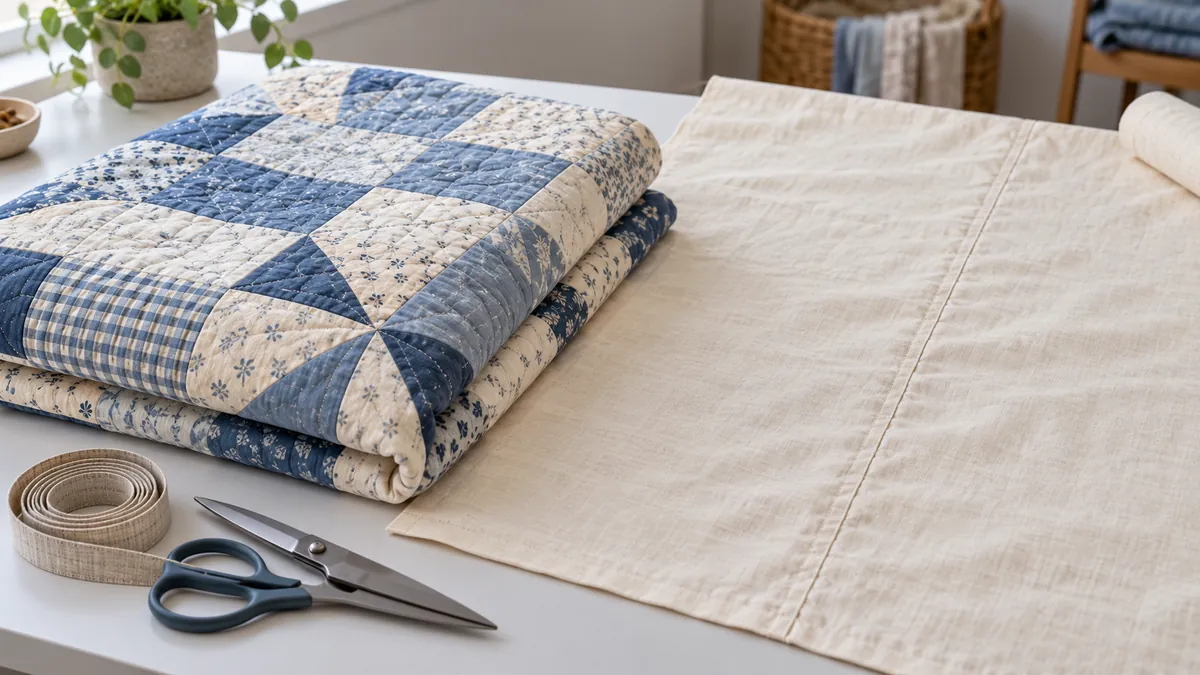
Measure the quilt and add overhang
Start with the quilt top’s actual width and height. Measure in more than one place if the edges are uneven, and allow for the widest and longest dimensions that must be covered. Do not rely only on the pattern’s planned size after piecing.
Backing generally needs to extend beyond the top for the intended quilting process. Ask your quilter or check your machine setup for the required extra on each side. The example below uses 4 inches per side to demonstrate the calculation; it is not a universal requirement.
Required backing width = quilt width + 2 × side overhang
Required backing height = quilt height + 2 × end overhang
The Jolbox tool uses one overhang value on every side. If your quilter specifies different side and end allowances, calculate the required rectangle separately rather than assuming one value fits both directions. Batting requirements are separate from backing fabric quantities.
Use fabric width that is actually available
Usable width is the width left after removing selvages and any damaged or unsuitable edges. A nominal bolt width is not necessarily the cutting width. Check the fabric, particularly after any preparation you intend to do before cutting.
Compare that usable width with the backing rectangle. A single panel may fit when using extra-wide backing. Narrower fabric may require two or more panels joined along their long edges. The total area of purchased fabric is not enough to establish a cutting plan: the rectangle must fit the available width and length in the chosen orientation.
Directional prints add another constraint. Rotating a panel can turn the design sideways or reverse a one-way motif. Pattern matching may require extra length beyond a geometric estimate, so establish the layout before treating a calculated yardage as an order quantity.
Account for seams between panels
With n equal-width panels, each usable width F, and seam allowance s on each joining edge:
Joined width = n × F − 2 × s × (n − 1)
Total cut length = number of panels × panel run length
Yardage = total cut length in inches ÷ 36
Each joining seam consumes an allowance from both pieces. Two panels have one join, so subtract two seam allowances. Three panels have two joins, consuming four seam allowances. Do not subtract an allowance from the two outside edges unless your finishing plan separately requires it.
The Quilt Backing Calculator models equal-width strips with vertical or horizontal joins. For vertical panels, their combined widths cover backing width and each strip runs the backing height. For horizontal panels, those roles reverse. Its result is a simple full-strip cutting plan, not an optimized layout using diagonal joins, scraps or differently sized pieces.
Worked example: a 60-by-80-inch quilt
Assume 4 inches of overhang on every side, 42 inches of usable fabric width, a 0.5-inch seam allowance on each joining edge, and vertical panels.
| Quantity | Calculation | Result |
|---|---|---|
| Required width | 60 + 2 × 4 | 68 inches |
| Required height | 80 + 2 × 4 | 88 inches |
| Two-panel joined width | 2 × 42 − 2 × 0.5 | 83 inches |
| Total strip length | 2 × 88 | 176 inches |
| Unrounded yardage | 176 ÷ 36 | About 4.89 yards |
| Purchase in quarter-yard steps | Round upward | 5 yards |
One 42-inch panel cannot cover 68 inches. Two panels are wide enough after the join, leaving surplus width to trim or distribute according to the layout. Five yards provides 180 inches of length, only 4 inches more than the two required 88-inch strips. That small difference is not an assumed shrinkage or pattern-matching allowance.
With the same inputs but horizontal panels, two 42-inch widths join to only 83 inches, short of the required 88-inch height. Three panels give 124 inches across the joined dimension. Each runs 68 inches, so the total is 204 inches, or about 5.67 yards, rounded to 5.75 yards in quarter-yard steps. Orientation changes the order quantity.
Check the plan before buying or cutting
Confirm overhang with the person doing the quilting, usable width with the actual fabric, and the joining seam allowance with your method. Keep units consistent: 36 inches make one yard, while 100 centimeters make one meter. Avoid treating square yards of area as linear yards from a bolt.
Decide separately how to handle washing, shrinkage, squaring ends and matching printed repeats. The calculator rounds the geometric yardage to a purchase increment; it does not automatically add those allowances. As with estimating driveway gravel, distinguish the measured requirement from an explicit ordering allowance instead of counting extra twice.
Use the calculator
Quilt Backing Calculator
Plan backing panels, seams and fabric yardage.