Home & Renovation
How Much Gravel Do I Need for a Driveway?
Multiply driveway length by width by gravel depth, using one unit system, to find volume. Divide cubic feet by 27 to get cubic yards. To estimate tons, multiply volume by the supplier’s bulk density; volume alone cannot determine gravel weight.
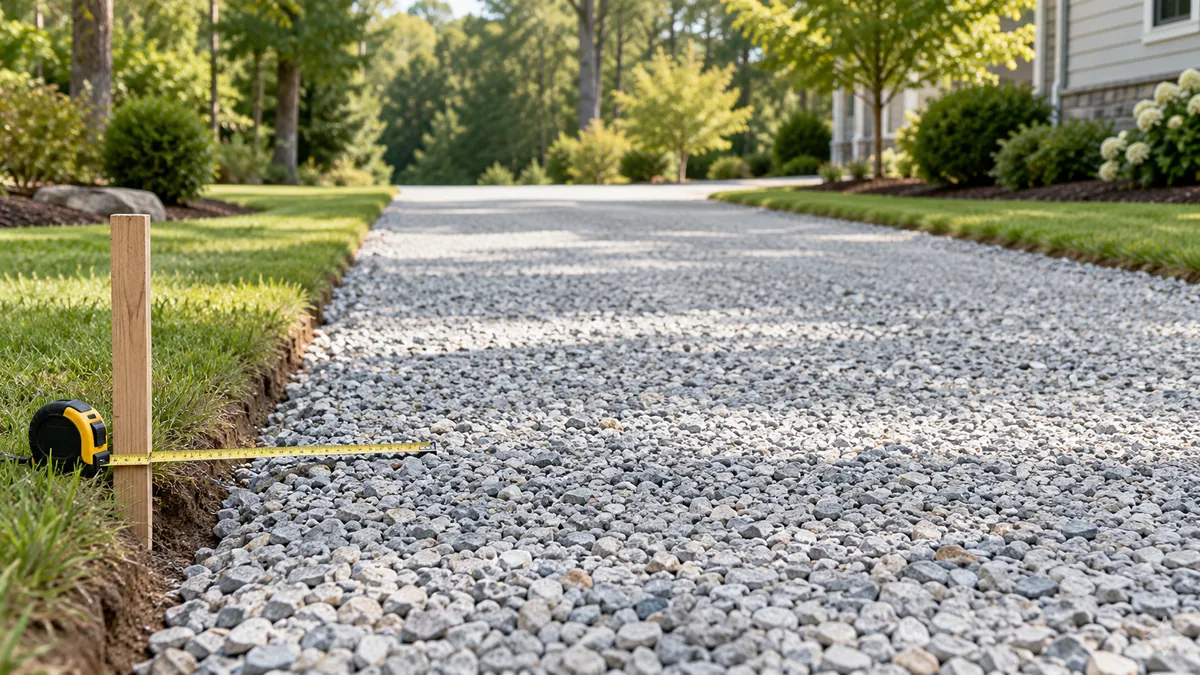
Measure the area you will cover
Measure the driveway’s length and usable width, including parking or turning areas that will receive gravel. For an irregular footprint, split the area into rectangles or triangles, calculate each area, and add them. A triangle’s area is base × perpendicular height ÷ 2. Avoid counting overlapping sections twice.
For a driveway that gradually widens, an approximate area is length × average width, where average width is the sum of the two end widths divided by two. This assumes the sides taper roughly in straight lines. Curves or abrupt width changes need more measured sections.
Record the unit beside each measurement. A depth in inches must be converted before multiplying by an area in square feet. The Gravel Driveway Calculator handles feet with inches, or meters with centimeters, and provides volume and weight estimates.
Choose depth before calculating volume
Doubling the depth doubles the volume for the same footprint. Measure several points when topping up an existing driveway. An average top-up depth is more useful than assuming the deepest rut represents the entire surface.
The arithmetic does not select a structurally suitable depth. Ground conditions, drainage, vehicle loads and the separate base and surface layers affect the construction specification. Establish those requirements first. If different layers use different aggregates, calculate each separately with its own density.
For dimensions in feet and depth in inches:
Depth in feet = depth in inches ÷ 12
Cubic feet = length × width × depth in feet
Cubic yards = cubic feet ÷ 27
For metric dimensions, multiply length in meters × width in meters × depth in centimeters ÷ 100 to obtain cubic meters. Do not divide cubic meters by 27; that conversion applies only to cubic feet becoming cubic yards.
Worked example: a 40-by-12-foot driveway
Assume a rectangular area 40 feet long and 12 feet wide, with a proposed gravel layer 4 inches deep. This depth is an example input, not a construction recommendation.
| Step | Calculation | Result |
|---|---|---|
| Footprint | 40 × 12 | 480 square feet |
| Depth | 4 ÷ 12 | 1/3 foot |
| Base volume | 480 × 1/3 | 160 cubic feet |
| Base cubic yards | 160 ÷ 27 | About 5.93 cubic yards |
| Volume with 10% allowance | 160 × 1.10 | 176 cubic feet |
| Order estimate | 176 ÷ 27 | About 6.52 cubic yards |
Keep unrounded values through the calculation. Rounding 1/3 foot to 0.33 before multiplication slightly understates the volume. Round the final order to the supplier’s selling increment instead of rounding each intermediate quantity.
Convert gravel volume to tons
Use the supplier’s bulk density for the selected aggregate in its relevant condition. Bulk density includes spaces between stones; solid-rock density is not interchangeable with loose aggregate density. Material type, grading, moisture and compaction can change weight per unit volume.
Weight in pounds = cubic feet × bulk density in lb/ft³
US short tons = pounds ÷ 2,000
Metric tonnes = kilograms ÷ 1,000
Using an illustrative density of 100 lb/ft³, the allowance-adjusted volume weighs 176 × 100 = 17,600 pounds, or 8.8 US short tons. Without the allowance, it weighs 8 US short tons. These are not metric tonnes, and the assumed density should be replaced with the supplier’s figure.
If density is quoted directly in US short tons per cubic yard, multiply cubic yards by that value instead. Confirm whether a quoted “ton” means a US short ton or a metric tonne before comparing deliveries.
Allow for ordering without duplicating extra material
An allowance can cover measurement uncertainty, uneven ground or handling losses, but it is not a universal compaction factor. Ask whether the supplier’s recommendation refers to loose delivered volume or installed compacted volume. If a specification already accounts for compaction, do not silently add that adjustment again.
Apply a chosen allowance once to base volume, then calculate weight from the adjusted quantity. In the example, 10% extra is already included in 6.52 cubic yards and 8.8 short tons. Increasing both figures by another 10% would count the same allowance twice.
Check delivery increments, access restrictions and load capacity before ordering. A weight-based truck estimate does not assess vehicle volume limits or site accessibility. Keep delivery charges separate when planning monthly savings for a project. The distinction between measured need and purchase allowance also matters when calculating quilt backing fabric.
Use the calculator
Gravel Driveway Calculator
Estimate driveway gravel volume, weight and truckloads.