Garden & Outdoor
How Much Gravel Do You Need for Landscaping?
For decorative landscape gravel, multiply the area to cover by the additional layer depth in feet, then divide cubic feet by 27 for cubic yards. A 12 × 5 ft bed at 2 inches needs 10 cubic feet, about 0.3704 cubic yard, before an allowance. The right depth depends on the actual stones and intended finish.
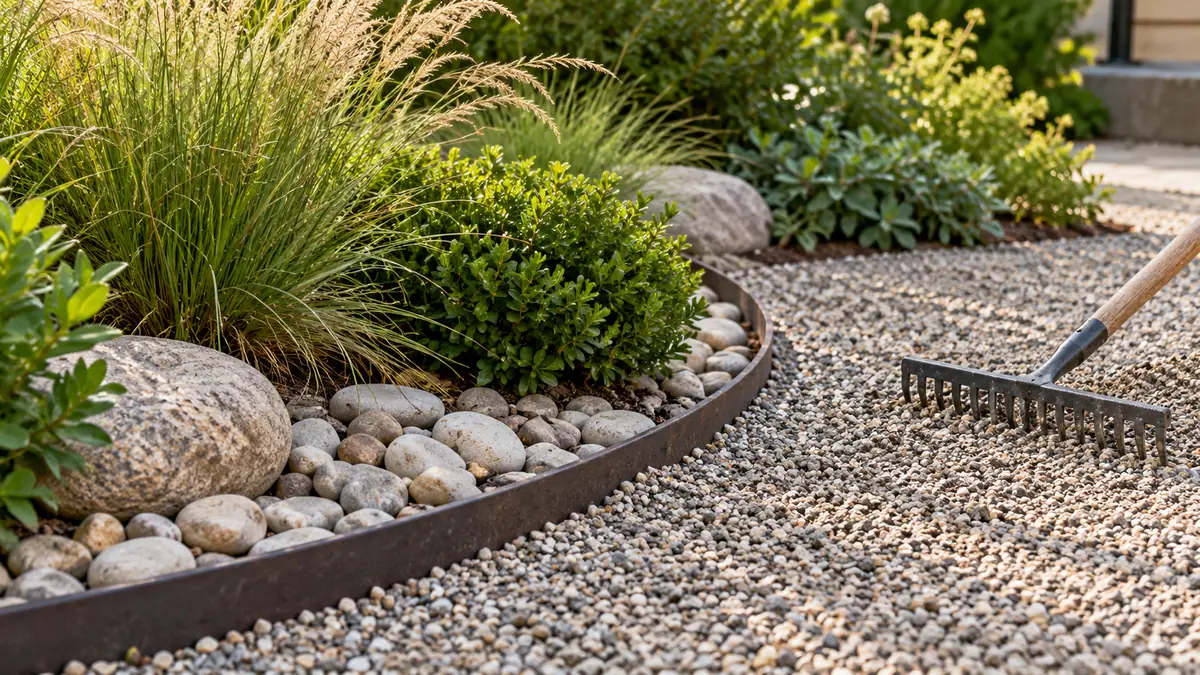
Measure the visible landscape surface
Start with a sketch of the bed, border or path that will receive decorative stone. Mark planting openings, stepping stones, large existing rocks and other areas that should remain uncovered. The rectangular outline around a curved planting bed can substantially overstate its actual area.
Measure the ground surface, not the spread of leaves overhead. A shrub’s canopy is not automatically an area deduction if gravel will extend beneath it. Conversely, a deliberate clear space around a trunk or plant base should not be filled just because it falls inside the sketch.
This guide concerns decorative coverage and pedestrian landscape features. A driveway gravel estimate has a different purpose: vehicle loads, base layers and driveway construction cannot be inferred from a decorative-bed calculation.
Fit simple shapes to an irregular bed
A rectangle has area length × width. A triangle uses base × perpendicular height ÷ 2; a circle uses π × radius². Combine nonoverlapping sections and subtract measured exclusions. Keep the sketch so each section can be identified later.
For example, a 10 × 4 ft rectangle joined to a nonoverlapping semicircle of radius 2 ft has area 40 + π × 2²/2, about 46.2832 sq ft. At 2 inches deep, its geometric stone volume is about 7.7139 cubic feet, or 0.2857 cubic yard.
For a winding path, measure successive short sections rather than multiplying the full length by its single widest point. An average width can be useful when the changes are gradual, but the estimate remains approximate. If separate sections need different top-up depths, calculate their volumes separately.
The Landscape Rock Calculator takes one rectangle. Run separate rectangular sections individually, or determine the total area first and represent it with an equivalent rectangle. Do not enter the bounding length and width while expecting the tool to infer curves or subtract stepping stones.
Select depth for the stone, not just the number
Two- and three-inch layers are common planning comparisons on decorative-stone coverage charts. A supplier’s marble-rock chart, for example, offers several depth columns rather than one universal thickness. That does not make any listed depth suitable for every garden or path.
Small gravel and larger rounded river rock do not create the same surface at the same average depth. Large pieces can leave visible gaps when the layer is too shallow relative to their size. Rounded stones and angular chips also arrange differently, affecting void spaces and how the surface feels underfoot.
Confirm the selected material’s coverage guidance and the intended use with the supplier or landscape professional. A decorative finish is not a specification for drainage performance, accessibility or a structural base. Rock is also not interchangeable with organic mulch, which has different maintenance and soil implications.
Calculate the layer you are adding
For measurements in feet and depth in inches:
Depth in feet = depth in inches ÷ 12
Cubic feet = covered square feet × depth in feet
Cubic yards = cubic feet ÷ 27
If topping up an existing bed, measure what remains at several locations. The added depth is the difference between the intended finish and the usable existing layer. Adding a full new layer over material already at the desired depth would over-order and could bury edging or planting details.
Use average depth thoughtfully on uneven ground. A deep depression is not necessarily representative of the whole bed; leveling or another preparation decision may be needed. The calculator spreads its entered volume uniformly and cannot assess the site.
Worked example: a narrow garden bed
Assume a rectangular 12 × 5 ft decorative bed, a new 2-inch layer and a separately chosen 5% ordering allowance. The dimensions and allowance are examples, not a landscape specification.
| Quantity | Calculation | Result |
|---|---|---|
| Covered area | 12 × 5 | 60 sq ft |
| Base volume | 60 × 2/12 | 10 ft³ |
| Base cubic yards | 10 ÷ 27 | About 0.3704 yd³ |
| With 5% allowance | 10 × 1.05 | 10.5 ft³ |
| Adjusted cubic yards | 10.5 ÷ 27 | About 0.3889 yd³ |
In metric, the base volume is about 0.2831685 m³ and the adjusted amount is about 0.2973269 m³. Those figures describe the same quantities, not extra material to add to the US-unit result. Keep intermediate values unrounded when converting.
Convert volume to tons using the actual product
A decorative rock name alone does not establish a reliable weight per cubic yard. Obtain the supplier’s loose bulk density, which includes spaces between pieces. Solid stone density is a different quantity and would overstate the weight of a loose pile.
For an explicitly assumed density of 100 lb/ft³, the adjusted 10.5 ft³ weighs 1,050 lb. Dividing by 2,000 gives 0.525 US short ton, equivalent to about 476.272 kg or 0.476272 metric tonne. The density is an arithmetic assumption, not a certified value for river rock, pea gravel or marble chips.
Different stone sizes, grading, moisture and packing can change bulk density. If the supplier quotes tons per cubic yard directly, use that matching volume unit instead. Confirm whether its word “ton” means US short ton or metric tonne before comparing an order.
Keep settlement and purchase rounding explicit
An allowance can cover a stated source of uncertainty or handling loss. It is not automatically the same as a settlement factor. Ask whether quoted coverage describes loose delivered material or an installed layer, and whether any adjustment is already included.
Do not add 5% to both adjusted volume and the tonnage calculated from it: that repeats the allowance. Whole-bag or delivery-increment rounding can add a separate surplus. Compare both the base requirement and the quantity supplied so the reason for extra material stays visible.
Before buying, confirm the measured exclusions, product size, additional depth, density and selling increment. Those decisions produce a more useful order estimate than choosing a generic “tons per garden bed” figure.
Use the calculator
Landscape Rock Calculator
Estimate decorative rock coverage and material weight.