Garden & Outdoor
How Much Mulch Do You Need for a Garden Bed?
Multiply garden-bed area by the mulch depth in feet to find cubic feet, then divide by 27 for cubic yards. For bags, divide cubic feet by the volume printed on each bag and round up. Choose depth for your plants and existing mulch rather than using one thickness everywhere.
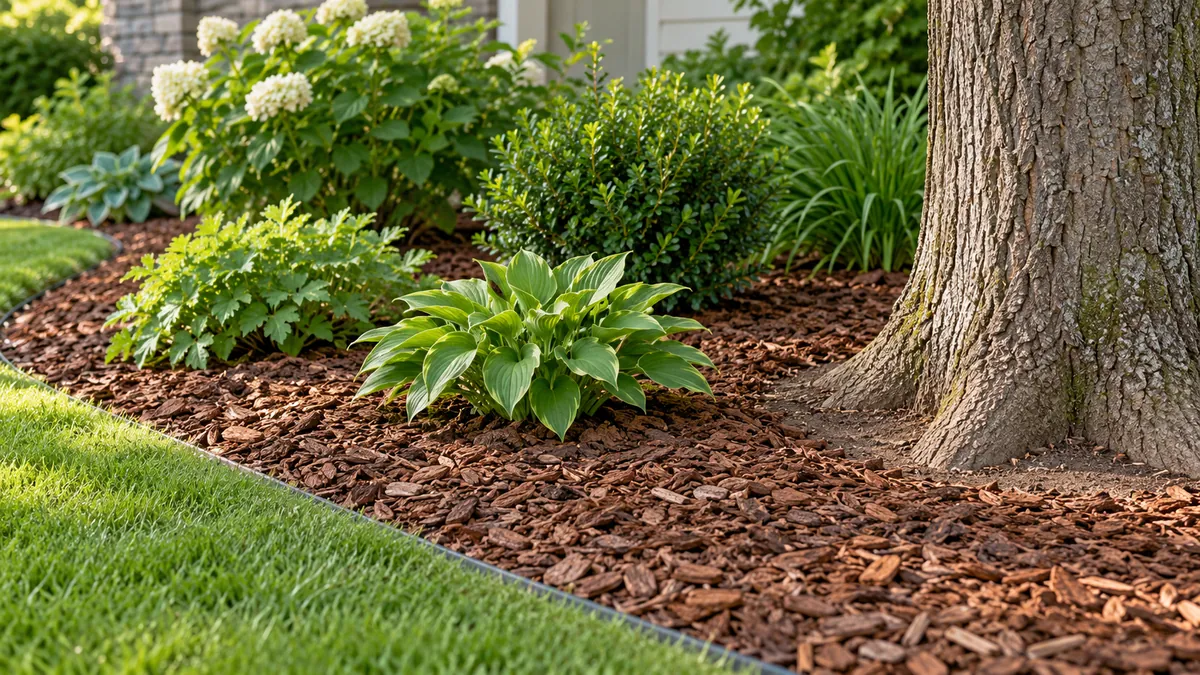
Measure the ground that will receive mulch
For a rectangular bed, multiply length by width. Exclude substantial areas occupied by paving, rocks or other features that will not be covered. Measure in feet if you want to use the Jolbox calculator’s length and width fields directly.
Do not subtract the full spread of a plant’s leaves if the ground beneath them will still receive mulch. Instead, distinguish the covered ground from gaps intentionally left around stems and trunks. Small exclusions may fall within a rough estimate’s uncertainty, but larger unmulched patches are worth measuring separately.
For a curved border, take several width measurements along its length. If widths change gradually, multiply total length by an average width for an approximation. When the bed has abrupt bulges or narrow sections, splitting it into smaller shapes gives more control than one bounding rectangle.
Choose a depth for the actual bed
Depth is the layer thickness, not the height of the mulch above a nearby lawn edge. Check existing material before topping up: you need the additional depth required, not another full layer simply because the calendar changed.
This guide uses a 3-inch new layer for a worked calculation. That is an example assumption, not a universal depth recommendation. Material type, existing mulch, drainage and the plants being grown affect the appropriate layer. A fine material can settle differently from coarse bark, so confirm how the supplied volume and expected finished depth relate.
Avoid packing mulch against plant stems or piling it against a tree trunk. Leave the root flare visible and keep the immediate trunk and stem areas clear. Do not bury those areas merely to make the whole bed match a uniform arithmetic depth. Where a tree’s root flare is already hidden, the volume estimate does not diagnose or resolve the underlying condition.
Convert depth and calculate volume
Depth in feet = depth in inches ÷ 12
Cubic feet = bed area in square feet × depth in feet
Cubic yards = cubic feet ÷ 27
For a rectangle: cubic yards = length × width × depth in inches ÷ 324
The Mulch Calculator takes a rectangular length and width in feet and depth in inches. For an irregular bed, calculate each section separately and add the unrounded volumes. Its output is a geometric volume estimate; it does not choose a horticulturally suitable depth or automatically deduct plants.
For a metric estimate outside those fields, multiply square meters by depth in centimeters divided by 100 to obtain cubic meters. One cubic meter is 1,000 liters. A bag volume in liters must be compared with a total in liters, not directly with cubic feet.
Worked example: a 20-by-10-foot bed
Assume a 200-square-foot bed needs a new 3-inch layer, with no substantial excluded areas.
| Quantity | Calculation | Result |
|---|---|---|
| Bed area | 20 × 10 | 200 sq ft |
| Depth | 3 ÷ 12 | 0.25 ft |
| Mulch volume | 200 × 0.25 | 50 ft³ |
| Bulk volume | 50 ÷ 27 | About 1.8519 yd³ |
| Two-cubic-foot bags | 50 ÷ 2 | 25 bags |
| Three-cubic-foot bags | Round up(50 ÷ 3) | 17 bags |
Seventeen 3-ft³ bags supply 51 ft³. The extra cubic foot comes from whole-bag rounding, not from an additional allowance chosen for settlement. Keep those two sources of surplus distinct when comparing quantities.
If an explicit 10% ordering allowance is appropriate for your situation, the same base volume becomes 55 ft³, or about 2.0370 yd³. That would require 28 two-cubic-foot bags or 19 three-cubic-foot bags. The calculator’s basic 50-ft³ estimate does not include this optional adjustment; do not add it twice.
Handle circular and mixed-shape beds
A circular bed has area π × radius². Radius is half the diameter; entering the full diameter as radius makes the calculated area four times too large. For a 10-foot diameter, area is about 78.54 sq ft. At 3 inches, that is about 19.635 ft³, or 0.7272 yd³.
For a bed made from a rectangle plus a semicircle, add the rectangle’s area to half the circle’s area, provided they do not overlap. Apply the chosen depth to the combined area. If sections need different top-up depths, compute their volumes individually instead.
These are the same dimensional principles used in driveway gravel measurement, but mulch purchasing should normally use its stated volume. Do not convert mulch to weight using a gravel density; moisture and material composition make that comparison unsuitable.
Compare bags and bulk on matching units
Read each bag’s volume rather than assuming a package’s size or weight establishes coverage. Bags of different volumes cannot be compared by bag count alone. For bulk supply, confirm the selling unit, order increment and delivery charge before rounding the order.
Coverage claims also depend on depth. A bag covering an area at 2 inches will cover less area at 3 inches; multiplying the advertised coverage without checking that assumption can understate the purchase. Keep an allowance explicit, measure existing mulch, and avoid turning a volume surplus into an unnecessarily thick layer around plants.
Use the calculator
Mulch Calculator
Find the right amount of mulch for your project.