Pets & Aquariums
How Many Calories Does a Dog Need Per Day?
A starting estimate for a healthy adult dog is resting energy requirement (RER) multiplied by a suitable maintenance factor. A 10 kg neutered adult at ordinary activity works out to about 630 kcal per day. That is a starting comparison, not a prescription; the appropriate intake depends on the individual dog.
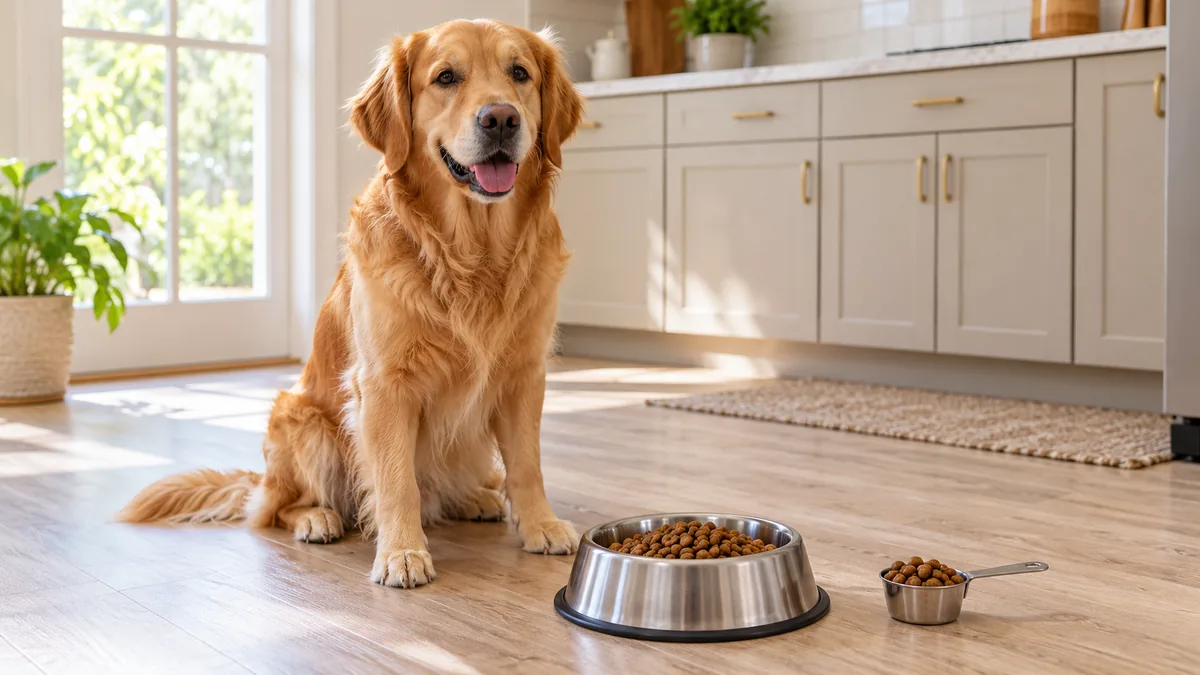
Start with the calorie budget, then choose a portion
A bowlful is a volume, not a calorie target. Two foods can supply different amounts of energy in the same cup, so first estimate daily calories and then translate that estimate using the food’s label. Keep the amount eaten separate from the amount served: leftovers, shared bowls and food from other people can make those figures differ.
The Dog Calorie Calculator makes that sequence explicit. It shows resting energy, one selected factor and the resulting daily estimate. The optional food field translates the calorie budget into cups or grams. It does not evaluate whether a particular food is nutritionally appropriate.
What does RER tell you?
Resting Energy Requirement is an estimate of energy used at rest. It is not automatically the amount to feed a dog living an ordinary active day. Use weight in kilograms in the exponent formula:
RER in kcal/day = 70 × body weight in kg^0.75
Estimated daily energy = RER × one applicable factor
Kilograms = pounds × 0.45359237
For 10 kg, RER is 393.6389 kcal/day. At 20 kg it is 662.0191 kcal/day. Doubling weight therefore does not double this estimate. The exponent accounts for the nonlinear relationship in this model; multiplying every kilogram by one fixed calorie allowance would give a different calculation.
Pet-food calories are normally discussed as kilocalories, abbreviated kcal. Keep that unit throughout the calculation. There is no need to multiply the displayed feeding target by 1,000 before comparing it with a label’s kcal per cup.
Which factor fits a puppy, adult or senior?
The Merck Veterinary Manual’s nutrition reference lists adult maintenance factors of 1.6 for neutered dogs and 1.8 for intact dogs. Its puppy estimates are higher. AAHA’s energy-requirement table specifies growth factors of 3 below four months and 2 from four months while growing.
These are alternatives, not ingredients to stack. A weaned puppy using a growth factor does not also receive an adult neuter multiplier. Transition from growth to maintenance depends on development, so a breed’s maturity and the veterinarian’s assessment matter more than choosing a convenient birthday.
For ordinary adult activity, Jolbox uses the neutered or intact maintenance estimate. Its low setting uses 1.2 from AAHA’s inactive range; high represents light work at 2.0, not heavy athletic work. Selecting either replaces the ordinary maintenance factor. A lively walk does not establish that a dog meets a working-dog energy category.
Senior is not an instruction to cut every dog’s food by the same percentage. Health, muscle condition and activity can change in different directions. Jolbox retains the selected adult estimate in senior mode and explains that it may need veterinary adjustment.
Worked example: a 10 kg neutered adult
Assume ordinary activity, a complete food labeled 350 kcal per cup, and no other food initially. These label values are illustrative, not a product recommendation.
| Step | Calculation | Result |
|---|---|---|
| Resting energy | 70 × 10^0.75 | 393.6389 kcal/day |
| Maintenance estimate | 393.6389… × 1.6 | 629.8223 kcal/day |
| Displayed target | Round only at the end | About 630 kcal/day |
| Food before treats | 629.8223… ÷ 350 | About 1.80 cups/day |
| Two equal meals | 629.8223… ÷ 2 | About 315 kcal each |
Retain the unrounded calculation until displaying the result. More decimal places do not make the underlying feeding estimate more certain. Splitting a target into two meals is arithmetic, not a universal schedule for puppies or dogs with medical needs.
Read the energy unit before measuring food
AAFCO’s calorie-label explanation distinguishes energy per kilogram from familiar units such as a cup or can. Use the actual package and product variety; similar-looking foods are not interchangeable calorie references.
If a dry food states 3,500 kcal/kg, divide by 1,000 for 3.5 kcal/g. A 350-kcal portion then weighs 100 g. That does not establish how much a household cup weighs. Use the label’s cup value or a measured mass rather than assuming that a cup always contains 100 g.
Jolbox’s gram option expects kcal per 100 g. The same 3,500 kcal/kg becomes 350 kcal/100 g. Entering 3,500 in that field would make the calculated gram portion ten times too small. Check both the number and denominator before feeding.
Count training rewards inside the daily total
AAHA’s obesity-prevention guidance limits treats and other extras to no more than 10% of daily calories as general guidance. That is a ceiling, not a requirement to add extra food.
Using the rounded 630-kcal budget for a simple planning example, 10% is 63 kcal. If training rewards actually provide 50 kcal, the complete-food allowance becomes 630 − 50 = 580 kcal. At 350 kcal/cup, that is about 1.66 cups, divided across the day’s feeding. Feeding 1.80 cups plus those rewards would exceed the example budget.
Record chews, toppers and food used for medication too. If kibble is used for training, set it aside from the measured daily ration instead of counting it as both a meal and an added reward. Follow a veterinary diet plan when its rules differ from a general treat allowance.
Check the estimate against the dog over time
The WSAVA nutrition toolkit supports assessment beyond a formula, including weight, body condition, muscle condition and diet history. Bring a record of actual intake and weight trends to the veterinary team rather than repeatedly changing factors until the calculator matches the bag.
Unexplained weight change, poor appetite or illness needs assessment. Weight-loss calculations require a veterinary-established ideal weight; current overweight weight does not identify that target. Pregnancy, lactation, intensive work and recovery also need individual plans. The useful result is a transparent starting budget that can be checked and adjusted, not a promise that one equation predicts every dog’s needs.
Use the calculator
Dog Calorie Calculator
Estimate dog calorie needs, meals and food portions.