Pets & Aquariums
How Many Calories Should a Cat Eat Per Day?
A 4 kg neutered adult cat has an estimated RER of about 198 kcal per day; a 1.2 maintenance factor gives roughly 238 kcal per day. Use this as a starting estimate, then check actual intake, body condition and weight trends with your veterinarian. It is not a universal ration for every 4 kg cat.
Plan around the food the cat actually eats
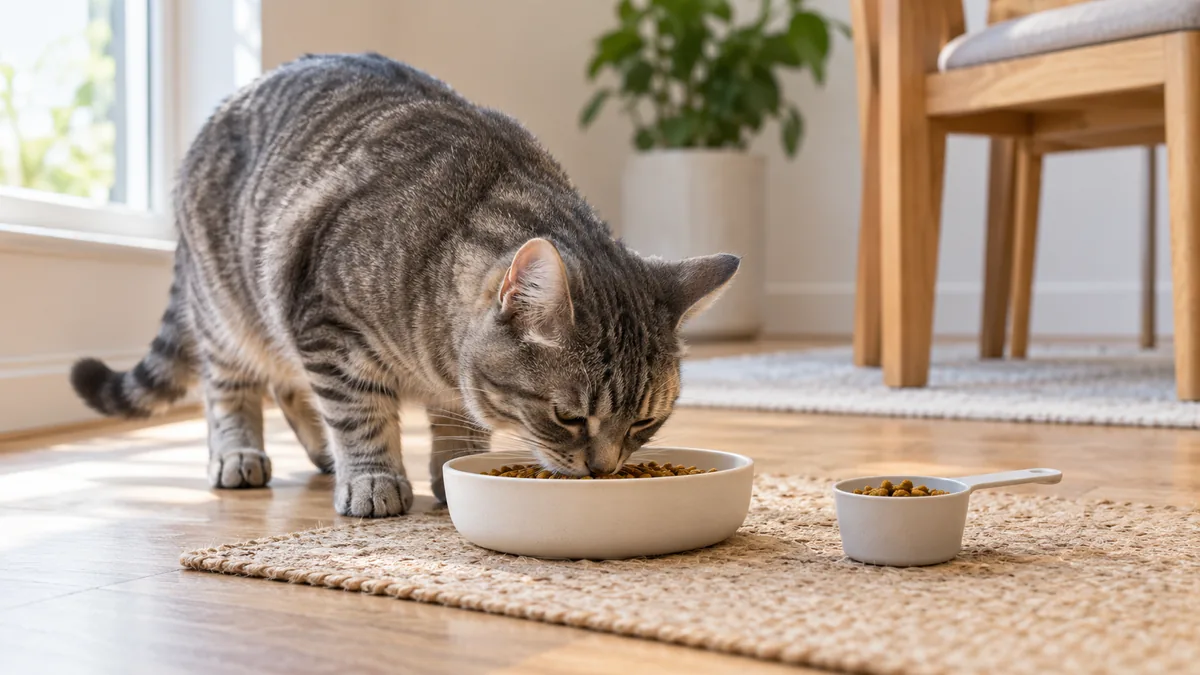
For a cat eating both canned food and kibble, the main calculation is a shared calorie budget. A can is not a fixed energy unit, and dry food is not measured on the same volume basis as wet food. Start by recording each product, its label calories and the amount consumed, including leftovers.
In a multi-cat home, food disappearing from a shared bowl does not show how much each animal ate. Separate measured feeding can make an intake record more useful. Before reducing food, distinguish an accounting problem from an actual change in one cat’s appetite or weight.
The Cat Calorie Calculator estimates the total budget and converts it to one food’s units. Mixed feeding requires allocating that budget between products, as shown below.
Use cat-specific energy factors
The RER equation uses kilograms, even if you weigh your cat in pounds:
RER = 70 × body weight in kg^0.75
Daily calorie estimate = RER × one selected cat factor
1 lb = 0.45359237 kg
The Merck Veterinary Manual lists maintenance factors of 1.2 for neutered adult cats and 1.4 for intact adults, and a growth factor of 2.5 for healthy kittens. Do not borrow a dog’s adult multiplier merely because the weight is the same.
A weaned kitten’s growth estimate replaces the adult factor; it is not multiplied by it. At 4 kg, RER is 197.9899 kcal/day. Multiplying by 2.5 gives about 494.97, displayed as 495 kcal/day. That is a mathematical comparison at the stated weight, not an instruction that every kitten should eat that amount. Nursing newborns need a different feeding assessment.
Does being indoors change the answer?
Indoor and outdoor describe location, not a measured energy expenditure. One indoor cat may climb and play regularly, while another sleeps most of the day. Outdoor access alone cannot identify the calories burned or compensate for illness, cold exposure or an unknown food source elsewhere.
Jolbox keeps the ordinary adult estimate the same for indoor and outdoor selections. Active mode uses the upper endpoints in AAHA’s adult ranges: 1.4 for neutered cats and 1.6 for intact cats. It selects one factor rather than adding a separate activity multiplier.
Neutered status is relevant to the starting comparison, but it does not make the calculation individualized. Senior cats also should not receive an automatic universal reduction. Appetite, digestion, muscle condition and health can require a different plan; an age label alone cannot settle it.
Worked example: convert 238 kcal into food
For a healthy 4 kg neutered adult in ordinary maintenance mode:
| Item | Calculation | Approximate result |
|---|---|---|
| RER | 70 × 4^0.75 | 197.9899 kcal/day |
| Daily estimate | 197.9899… × 1.2 | 237.5879 kcal/day |
| Whole-kcal display | Final rounding | 238 kcal/day |
| Wet food at 80 kcal/can | 237.5879… ÷ 80 | 2.97 cans/day |
| Dry food at 400 kcal/cup | 237.5879… ÷ 400 | 0.594 cup/day |
The wet and dry rows are alternative full-day amounts. Feeding both entire amounts would supply about twice the estimated energy. Can and cup values are hypothetical; replace them with the exact variety and package size you use.
Volume alone cannot rank food energy. Water content often makes wet food less energy-dense by weight, but individual products differ. Compare label kcal per gram or per serving rather than assuming every can is low-calorie or every dry food has the same density. The AAFCO calorie-label guide explains the distinction between per-kilogram and household-unit statements.
Split one budget between wet and dry food
Use the rounded 238-kcal estimate as an explicitly simplified planning budget. Suppose the plan includes two cans at 80 kcal each and treats totaling 10 kcal:
Wet food = 2 × 80 = 160 kcal
Remaining dry-food budget = 238 − 160 − 10 = 68 kcal
Dry food at 400 kcal/cup = 68 ÷ 400 = 0.17 cup
This combination supplies 160 + 68 + 10 = 238 kcal. The 0.17 cup is the dry portion for the entire day, not an additional amount at every meal. If dividing it between two feedings, each dry portion is 0.085 cup.
For a label reading 4,000 kcal/kg, energy is 4 kcal/g. The same 68-kcal allocation would weigh 17 g. That mass calculation does not assume a universal grams-per-cup value. It uses the chosen food’s stated density. Weighing a small dry ration can be easier than estimating a tiny fraction of an ordinary cup.
Monitor body condition without chasing one number
Use a consistent scale and note intake and trends, while asking the veterinary team to assess body condition and muscle condition. The WSAVA nutrition resources include tools for those assessments. A dense coat or a visually large belly is not enough to establish an ideal body weight yourself.
A feeding estimate also does not guarantee adequate nutrients when the main diet is displaced by extras. Choose a suitable complete diet and discuss changes with the veterinarian, especially for kittens or cats receiving therapeutic food. An unexplained drop in appetite is a reason for assessment, not proof that a lower ration is working.
Weight loss must protect food intake
An overweight cat’s current weight and veterinary-established ideal weight are different inputs. Jolbox’s weight-loss mode requires that separate ideal weight and confirmation of veterinary guidance; it does not infer ideal weight from the current reading. A starting figure still needs an appropriate diet, intake monitoring and follow-up.
Do not fast a cat or force a rapid drop in food intake to reach a calculator number. Merck’s discussion of feline hepatic lipidosis explains the serious risk associated with inadequate intake and food deprivation. Contact a veterinarian promptly if the cat stops eating, rather than waiting for a planned weigh-in.
Keep the calorie calculation in its proper role: it helps compare a proposed ration with a transparent estimate. It cannot diagnose a weight problem, decide the nutritional needs of an ill cat or replace a veterinary feeding recommendation. For another species, use the separate dog calorie guide, whose factor choices and feeding questions differ.
Use the calculator
Cat Calorie Calculator
Estimate cat calorie needs, meals and food portions.