Home & Renovation
How to Calculate Concrete for a Slab
Multiply slab length by width by thickness to find concrete volume, converting thickness from inches to feet first. Divide cubic feet by 27 for cubic yards. Add any ordering allowance once, then compare that volume with ready-mix quantities or the labeled mixed yield of bags.
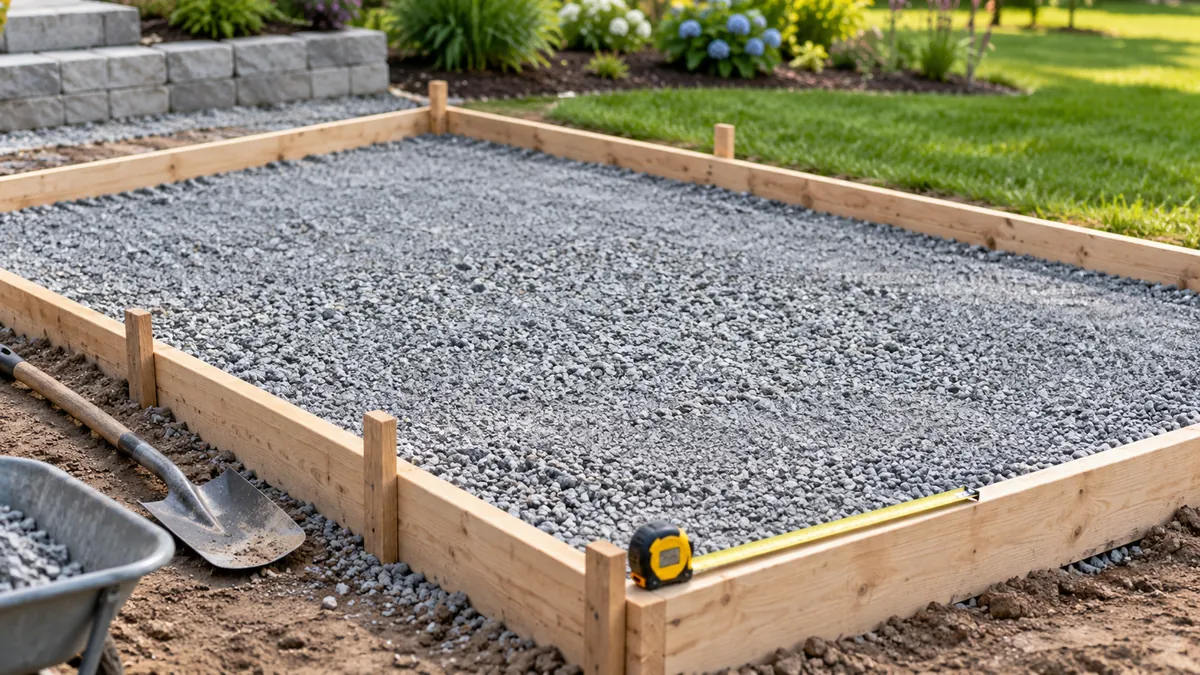
Measure the filled space inside the forms
Use the slab’s intended concrete dimensions, not the outside dimensions of the form boards. Measure length and width inside the forms and establish the concrete thickness from the prepared base to the planned top surface. A thicker form board does not necessarily indicate the slab’s concrete thickness.
Check several points across the base. An uneven subgrade can leave extra space below the planned surface, increasing volume even when the top dimensions stay fixed. The calculator assumes the thickness you enter represents the section being estimated; it does not detect low spots.
This is a quantity calculation, not a slab design. Establish suitable thickness, reinforcement, drainage and other construction requirements for the intended use before ordering. If the design includes thickened edges or footings, calculate their additional volume separately without double-counting the slab volume already above them.
Convert thickness before multiplying
Length and width are often measured in feet while slab thickness is measured in inches. All three dimensions must use compatible units in the volume formula.
Thickness in feet = thickness in inches ÷ 12
Concrete in cubic feet = length (ft) × width (ft) × thickness (ft)
Concrete in cubic yards = cubic feet ÷ 27
The shortcut for length and width in feet and thickness in inches is length × width × thickness ÷ 324 to obtain cubic yards. The denominator combines 12 inches per foot and 27 cubic feet per cubic yard.
For metric measurements, use length in meters × width in meters × thickness in centimeters ÷ 100 for cubic meters. One inch is 2.54 cm, one foot is 0.3048 m, and one cubic yard is 0.764554857984 m³. Do not use the linear feet-to-yards factor of three for a volume conversion.
Worked example: a 12-by-10-foot slab
Assume a uniformly rectangular slab 12 feet long, 10 feet wide and 4 inches thick. The chosen thickness is an arithmetic example, not a recommendation for a particular load or site.
| Step | Calculation | Result |
|---|---|---|
| Surface area | 12 × 10 | 120 sq ft |
| Thickness | 4 ÷ 12 | 1/3 ft |
| Base volume | 120 × 1/3 | 40 ft³ |
| Base cubic yards | 40 ÷ 27 | About 1.4815 yd³ |
| With 10% allowance | 40 × 1.10 | 44 ft³ |
| Adjusted cubic yards | 44 ÷ 27 | About 1.6296 yd³ |
The exact metric equivalent uses 3.6576 m × 3.048 m × 0.1016 m, giving 1.13267386368 m³ before allowance and about 1.24594 m³ after 10%. Entering approximately rounded metric dimensions can produce a slightly different result.
The Concrete Calculator supports slab sections, unit selection, an allowance and optional bag yield. For the example, enter 12, 10 and 4 in its US customary fields and apply the allowance once. Preserve intermediate precision before rounding an order to the supplier’s increment.
Compare ready-mix with bagged concrete
Ready-mix is ordered by a stated volume, commonly cubic yards or cubic meters. Ask the supplier about order increments, minimum quantities, delivery conditions and the mix specification required for your project. The calculated 1.6296 yd³ is a volume estimate, not a confirmation that the supplier sells that exact increment.
For bags, use the product’s mixed yield, not its dry weight as though pounds were a volume. Different products can have different yields for the same package weight.
Bag count = round up(adjusted concrete volume ÷ mixed yield per bag)If a chosen bag yields 0.60 ft³, the allowance-adjusted example requires 44 ÷ 0.60 = 73.333… bags, rounded up to 74 bags. Without the allowance, 40 ÷ 0.60 requires 67 bags after rounding. Verify 0.60 ft³ against the actual label; it is a stated assumption, not a yield promised for every bag.
Keep allowances and related materials separate
An optional allowance can account for modest measurement uncertainty and handling loss. It does not correct a poorly measured base or establish a universal waste percentage. If you already included extra thickness, explain what it represents before applying a second adjustment.
Do not count gravel base material as concrete. If the design requires a separate aggregate layer, calculate that layer’s volume independently using the gravel measurement method and its own material assumptions. Likewise, reinforcement and formwork quantities are not included in concrete volume.
Before ordering, check that every depth is in the expected unit, all sections are included and no overlap has been added twice. A small thickness error affects the whole slab area. Quantity estimates also do not establish mixing capacity, placement timing or safe handling arrangements; those need a separate project plan.
Use the calculator
Concrete Calculator
Estimate slabs, footings, columns, bags and concrete cost.