Food & Kitchen
How Many Cups Is 100 Grams? Ingredient Conversion Guide
There is no single cup equivalent for 100 grams. Using the references below, 100 g of all-purpose flour is about 0.8333 US cup, while 100 g of granulated sugar is about 0.5051 cup. Grams measure mass; cups measure volume, so the ingredient and how it is measured determine the conversion.
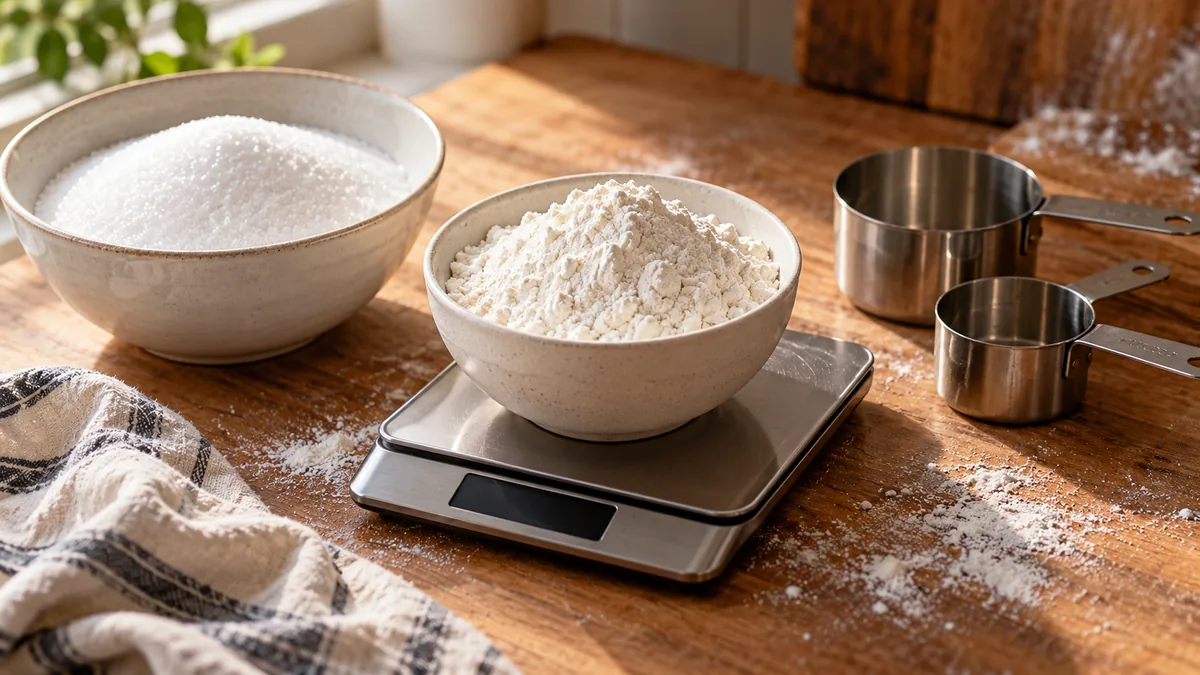
Choose the ingredient before choosing a cup amount
A cup specifies space inside a measure. It does not specify the mass of everything that can fill it. Flour, sugar crystals and rolled oats occupy that space differently, including the air between particles. Equal masses therefore need not fill equal volumes.
Water offers a familiar comparison: assuming roughly 1 g per mL for kitchen arithmetic, 100 g occupies about 100 mL. That is not a rule to apply to flour or butter. A mass-to-volume conversion needs a reference for the chosen ingredient and its preparation.
The Grams to Cups Calculator exposes its ingredient-specific grams-per-cup value rather than applying one constant to the entire pantry. Select grams-to-cups, enter 100 and check the ingredient description beside the result.
A documented table for 100 grams
The baking references are from King Arthur Baking’s ingredient weight chart. Values describe the listed preparation, not an exact universal density. Water uses the stated volume-and-density assumption instead.
| Ingredient and preparation | Reference grams per US cup | 100 g in US cups, approximately |
|---|---|---|
| All-purpose flour, spooned and leveled | 120 | 0.8333 |
| Granulated white sugar | 198 | 0.5051 |
| Brown sugar, packed | 213 | 0.4695 |
| Butter | 226 | 0.4425 |
| Water, assuming 1 g/mL | 236.6 | 0.4227 |
| Dry old-fashioned or quick-cooking oats | 89 | 1.1236 |
| Unsweetened cocoa powder | 84 | 1.1905 |
The chart gives butter as 113 g per half cup and cocoa as 42 g per half cup. Doubling those entries supplies the 226 and 84 g references used here and in Jolbox. Doubling a rounded reference does not create an exact physical measurement.
Read the particular oats row carefully. The same source lists its own King Arthur Rolled Oats at 113 g per cup, distinct from the 89 g ordinary old-fashioned/quick-cooking entry. At 113 g per cup, 100 g would be about 0.8850 cup instead of 1.1236. Product and reference selection matter; do not quietly swap between rows.
Calculate the amount rather than memorizing a shortcut
The calculation is mass divided by the selected mass-per-cup reference:
US cups ≈ grams ÷ reference grams per US cup
Grams ≈ US cups × reference grams per US cup
For flour, 100 ÷ 120 = 0.833333… cup. That is five-sixths of a cup under this reference. For granulated sugar, 100 ÷ 198 = 0.505050… cup, close to but not exactly half a cup. Half a cup using that sugar reference is 99 g.
These decimals are useful for understanding the difference. They do not imply that a home measuring cup can reliably distinguish four decimal places. If the recipe calls for 100 g and you have a suitable scale, weighing 100 g avoids choosing an approximate cup fraction.
The difference can become larger when a recipe is scaled. Three 100 g flour portions total 300 g; dividing once by 120 gives 2.5 cups. Rounding each individual portion to a convenient but inaccurate cup measure first can accumulate a larger deviation.
Packing is part of the reference
A flour cup filled by pushing the measure into a bag can contain a different mass from a lightly filled, leveled cup. King Arthur’s flour-measuring guidance explains its method for reproducing the intended reference. If using volume, follow the recipe author’s stated technique instead of assuming every cup-filling method is equivalent.
Packed brown sugar is another explicit condition. A loosely filled cup should not be expected to match the table’s packed reference. Likewise, cocoa is unsweetened powder here, not a sweetened drinking mix; dry oats are not cooked oatmeal.
Keep ingredient descriptions attached when saving a conversion. A note reading only “100 g equals half a cup” loses the information needed to know whether it fits the next ingredient. The table is a set of separate approximations, not interchangeable labels.
Check which cup your recipe means
A US customary cup is about 236.6 mL; NIST’s household guide rounds the household equivalent to 237 mL. A metric cup is 250 mL. Those capacities are close enough to confuse, but not identical.
At the same assumed water density, 100 g is about 0.4227 US customary cup and 0.4 metric cup. A full 250 mL measure holds about 5.7% more volume than a 236.6 mL measure. That comparison is about the measure’s capacity, not a measured change in flour density.
Jolbox’s ingredient table uses its stated US-cup references. Do not substitute a 250 mL cup while keeping every grams-per-cup number unchanged. When converting an international recipe, check the author’s actual weights and cup convention; a word such as “cup” by itself may not settle both questions.
Use a scale when the recipe already supplies grams
Put an empty bowl on the scale, tare it to zero and add the ingredient until the desired net mass is reached. Confirm that the display is in grams rather than ounces. Check the scale’s instructions, capacity and resolution for the amount being weighed; very small quantities can require a more suitable measure.
Weighing eliminates the need for a cup conversion, but it does not select the right ingredient or alter the recipe’s ratios. One hundred grams of sugar cannot replace 100 g of flour merely because the masses match.
For sourdough hydration, consistent flour and water weights are especially useful because the calculation compares masses. Use the original recipe’s gram amounts when available, and use this guide when understanding or adapting a volume instruction rather than as a promise of laboratory precision.
Use the calculator
Grams to Cups Calculator
Convert ingredient weights and US cup measures.