Food & Kitchen
How to Calculate Sourdough Hydration (Including Starter)
Sourdough hydration is total water divided by total flour, multiplied by 100. Include the flour and water inside your starter, not just the ingredients added to the mixing bowl. A 100% hydration starter contains equal weights of flour and water.
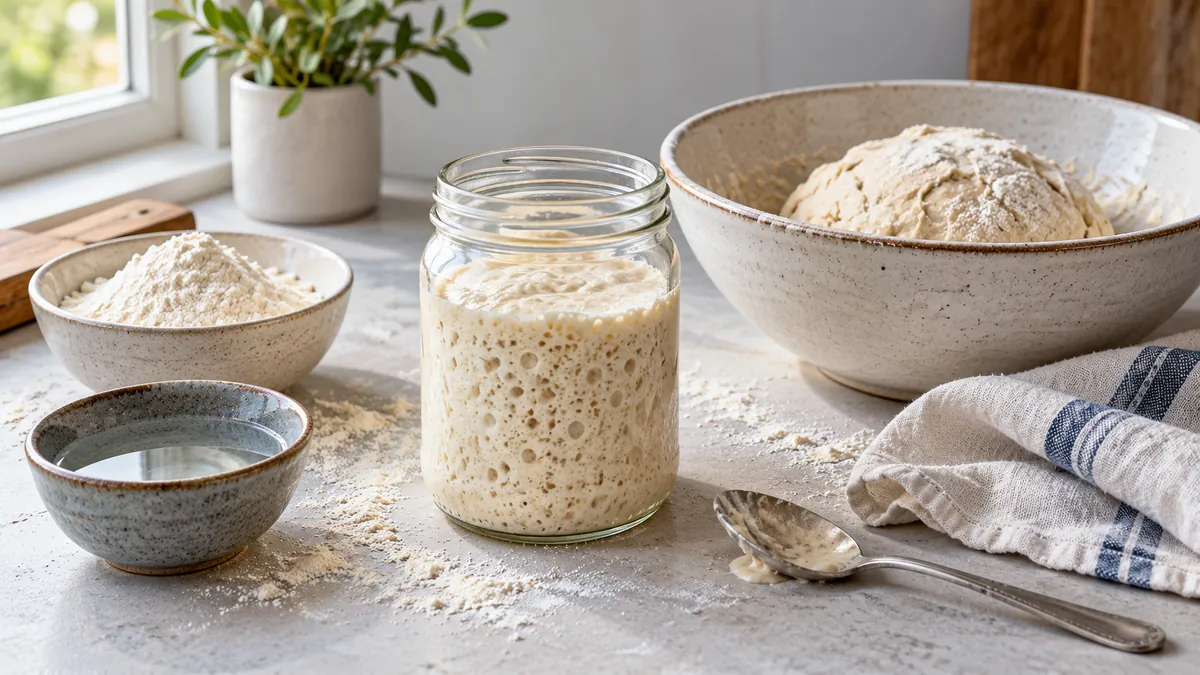
Hydration is a baker’s percentage
In baker’s percentages, total flour is the reference quantity and represents 100%. A recipe with 500 g flour and 350 g water has 350 ÷ 500 × 100 = 70% hydration. It does not mean water is 70% of the dough’s combined weight.
Use ingredient weights in grams. Measuring flour by volume introduces variation from packing and handling, while weighing keeps the ratio explicit. If a recipe lists flour in cups and water in milliliters, establish corresponding ingredient weights before applying this formula.
Other baker’s percentages use the same flour denominator: ingredient weight divided by total flour weight, multiplied by 100. Salt and oil are not added to that denominator. A recipe’s ingredient percentages can exceed 100%; they are not shares of the finished dough’s total mass.
Separate the starter into flour and water
Starter hydration describes water relative to flour inside the starter. It differs from the hydration of the final mixed dough. A stiff starter contributes less water per gram than a liquid starter, so treating all starters as equal halves changes the result.
Let S be starter weight and H its hydration percentage:
Starter flour = S ÷ (1 + H ÷ 100)
Starter water = S − starter flour
Total flour = main flour + extra flour + starter flour
Total water = main water + extra water + starter water
Dough hydration (%) = total water ÷ total flour × 100
For example, 150 g of a 50% hydration starter contains 100 g flour and 50 g water: 150 ÷ 1.5 = 100 g flour, then 150 − 100 = 50 g water. Dividing that starter into two equal 75 g portions would describe a different starter hydration.
The Sourdough Hydration Calculator separates these contributions and includes optional extra flour or water. Use the hydration of the starter actually weighed into the recipe, rather than automatically assuming its last feeding ratio describes its entire composition.
Worked example with a 100% hydration starter
Suppose the dough contains 500 g main flour, 350 g main water and 200 g starter at 100% hydration, with no extra flour or water.
| Component | Flour | Water |
|---|---|---|
| Main ingredients | 500 g | 350 g |
| Starter | 100 g | 100 g |
| Total | 600 g | 450 g |
Overall hydration is 450 ÷ 600 × 100 = 75%. Looking only at the main ingredients gives 70%, omitting the starter. Counting the entire starter as water is also incorrect because half of it is flour.
The recipe has 100 ÷ 600 × 100 ≈ 16.67% prefermented flour: the share of total flour already in the starter. This is a separate measure from the 200 g starter weight and the final 75% hydration.
Adjust water for a target hydration
Keep total flour fixed when solving for a water adjustment:
Target total water = target hydration ÷ 100 × total flour
Water adjustment = target total water − existing total water
For 600 g total flour, an 80% target requires 0.80 × 600 = 480 g total water. There are already 450 g, so add 30 g water. A 70% target requires 420 g total water, 30 g less than entered. Reduce the recipe’s water before mixing; do not add a negative amount.
Adding flour to already-mixed dough changes the denominator and recipe size. Keeping 450 g water while aiming for 70% requires 450 ÷ 0.70 ≈ 642.86 g total flour, about 42.86 g more than the original 600 g. That also changes salt and other ingredient percentages. It is a separate reformulation, not the calculator’s fixed-flour water adjustment.
Check what the percentage does not describe
Count late-added water and flour used to build an included preferment. Exclude discarded starter that never enters the dough. Avoid rounding the starter split too early, especially when its hydration differs from 100%.
These calculations use stated flour and water weights. They do not measure moisture already in flour or water contributed by milk, eggs or fruit puree. Do not treat the entire weight of those mixed ingredients as pure water without a separate composition assumption.
Hydration alone does not predict dough handling. Flour type, absorption, mixing and fermentation also affect texture. Compare those differences alongside hydration instead of treating a percentage as a guarantee of a particular loaf.
Use the calculator
Sourdough Hydration Calculator
Include starter flour and water in dough hydration.